
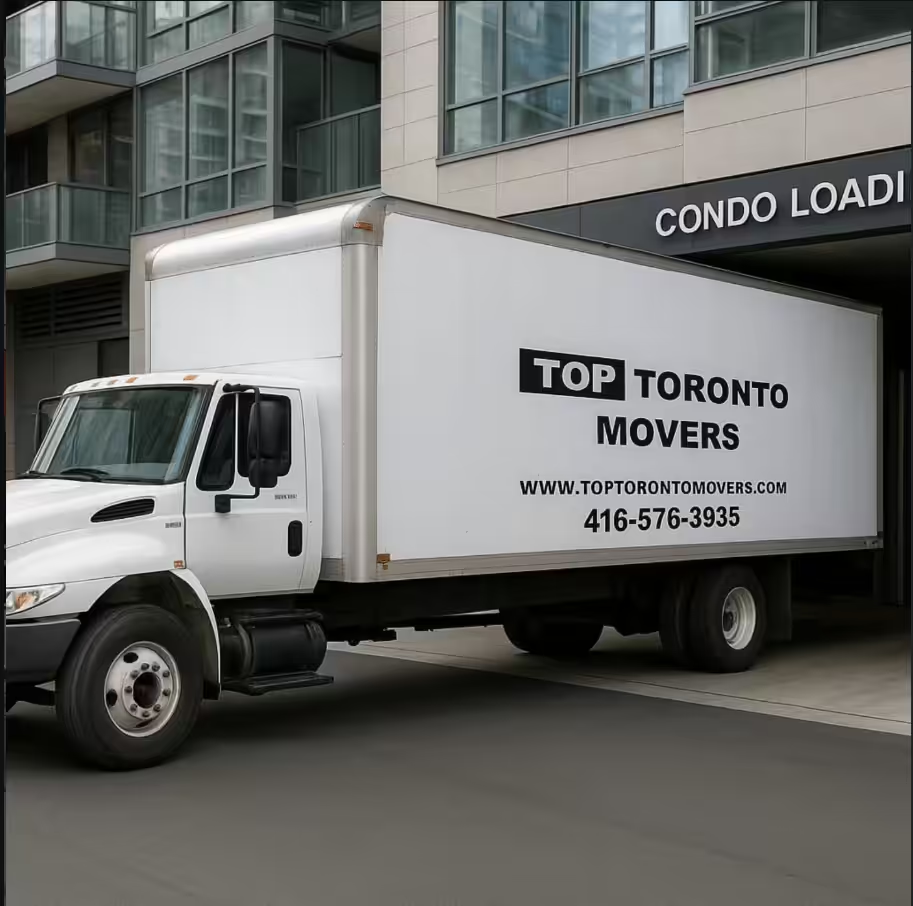
Can You Park a Moving Truck on a Toronto Street? Rules & Tips
A moving truck can make a Toronto move much easier — until you get to the address and realize there’s nowhere practical to unload. A legal street space might be across the road. The condo loading dock might have a height restriction. Or the elevator may be reserved, but the truck has no access to the building.
Those details affect more than convenience. They can change how long a move takes, how far furniture needs to be carried and whether the crew can keep to your building’s schedule. This guide explains the street-parking rules, the differences between condos and houses, and what to check before your movers arrive.
On this page 12 sections
- Can a moving truck park on a Toronto street?
- Where can a moving truck stop to load?
- Do you need a parking permit for a moving truck?
- Condo loading docks and elevator bookings
- Downtown streets versus residential streets
- Check truck dimensions and the carrying distance
- Moving-day parking checklist
- Realistic Toronto parking scenarios
- Common mistakes to avoid
- Frequently asked questions
- Official sources and further reading
- Plan your Toronto move
Can a moving truck park on a Toronto street?
Yes, in some locations while the truck is actively loading or unloading. Toronto’s official parking regulations specifically address moving vans. The permission is subject to all other parking and traffic rules at that location, so you still need to check the signs, curb restrictions and whether the truck can stop without creating a safety issue.
This distinction matters. A truck moving furniture into a house is different from a truck left unattended in a restricted area for several hours. A moving company should check the street situation at both the pickup and destination, not assume that the same approach works everywhere in Toronto.
Where can a moving truck stop to load?
The right answer depends on the street signs and how the space is used. The City distinguishes between no parking, no standing and no stopping restrictions. They are not interchangeable. The City also notes that there is no parking consideration for certain offences, including no-standing and no-stopping areas, fire routes, hydrants and sidewalks.
| Location or situation | What to do before moving day |
|---|---|
| Legal curb space | Check the posted rules and confirm the truck will be actively loading or unloading. |
| No Standing / No Stopping | Do not treat these as regular moving-truck loading areas; check the actual restriction. |
| Near a fire hydrant or in a fire route | Keep the area clear. Toronto prohibits parking within three metres of a fire hydrant. |
| Condo loading dock | Ask property management for approval, availability, vehicle clearance and the correct entrance. |
| Street space for a moving container | Check whether a separate street-occupation permit is required; this is different from a truck actively loading. |
For exact restrictions, use the City’s parking regulations and the signs on the street. If the situation isn’t clear, contact Toronto 311 before the booking date.
Do you need a parking permit for a moving truck?
Not every moving-truck stop requires a special permit. Toronto’s moving-van guidance allows street parking during active loading or unloading, subject to restrictions. However, a residential on-street parking permit is not a blanket authorization for a commercial moving truck to ignore signs or occupy a restricted space.
The City’s temporary on-street parking program has eligibility rules and its own conditions. If your move needs more than ordinary loading access — for example, space for a container or a street occupation — don’t assume a residential parking permit solves the problem.
The City’s street occupation permit information specifically lists moving containers among the equipment that may require a permit when placed in public space as part of a project. A parked moving truck and a container left in the roadway are not the same situation.
Condo loading docks and elevator bookings
A condo move has two schedules to manage: the crew’s moving time and the building’s access time. If either is missed, the move can become slower and more complicated.
Before booking, contact the concierge or property manager and ask:
- Is there a designated moving entrance, loading bay or service elevator?
- Do we need to reserve the loading dock separately from the elevator?
- What are the approved move-in and move-out hours?
- Are there truck height, length or turning restrictions at the entrance?
- Is an elevator deposit or certificate of insurance required?
- Do movers need to use protective floor coverings or elevator pads supplied by the building?
Condo rules are not identical across Toronto. The Condominium Authority of Ontario explains that corporations have governing documents and rules for day-to-day use of shared property. Your own building’s moving instructions are the ones to follow.
Our practical recommendation: If both pickup and delivery are condos, give each location enough time for loading, travel and unloading. Avoid overlapping elevator reservations if the same crew and truck must serve both buildings. For more about the moving service itself, see our Toronto condo movers page.
Downtown streets versus residential streets
Moving out of a CityPlace or King West tower is not the same as moving out of a house on a quiet Etobicoke street. Downtown, the nearest legal truck position may be a designated dock or loading area. In an older residential neighbourhood, the challenge may be street width, parked vehicles or a long carry from the closest legal space.
Both situations are manageable when identified early. What creates problems is finding out about a narrow lane, blocked driveway, signed parking restriction or distant loading entrance only when the truck arrives.
Try this: look at the pickup and delivery addresses separately. For each one, identify the intended truck location, the entrance the movers will use and the route between the two. Take photos of any unusual access issues and send them with your inventory.
Check truck dimensions and the carrying distance
Truck size is usually discussed in terms of how much furniture fits inside. In Toronto, the space outside the truck matters too.
A larger vehicle may be useful for an efficient one-trip move, but it might not fit into a building’s loading area or reach a tight residential entrance. Confirm the vehicle size your mover expects to bring and compare it with any dock restrictions given by the building.
Then consider the full carrying route: from the unit, along the hallway, through the service elevator, across the lobby or dock, and into the truck. If the truck must be farther away, the additional walking distance can increase moving time. That’s worth discussing when comparing Toronto moving costs.
Moving-day parking checklist
- Check both addresses. Confirm the exact pickup and delivery location, not just the nearest intersection.
- Look at curb signs. Note restrictions, time windows, hydrants and fire routes.
- Ask the building. Obtain written loading-dock and service-elevator instructions if applicable.
- Confirm vehicle fit. Check truck length and height when a dock or underground entrance is involved.
- Share photos. Send the truck approach, loading entrance, stairs and long walkways to your mover.
- Keep a backup plan. Identify a second legal loading option if the preferred position is unavailable.
- Reconfirm before move day. Verify any street work, building notices or reservation changes.
Realistic Toronto parking scenarios
Condo to condo: downtown Toronto to the waterfront
Both buildings have a service elevator, but only one has a full-size loading dock. The move needs separate elevator reservations, confirmed truck access and enough travel time between the buildings. The distance from each elevator to the vehicle may matter as much as the driving distance.
House move: Etobicoke to North York
The pickup house has street frontage, but the driveway is short. The delivery street has posted parking restrictions during part of the day. The crew should know the intended legal stopping area at each address before setting a start time.
Small apartment move: one heavy item and several boxes
A small job can still take longer when the truck must park well away from the entrance. Even if the furniture fits easily in the vehicle, a long carry or stair-heavy route can change the time estimate. For smaller moves, see small moving services in Toronto.
These are illustrative planning examples, not claims about the rules at any particular building or street.
Common mistakes to avoid
- Booking movers before checking the loading entrance and elevator requirements.
- Assuming a truck may use every curb space because it is a moving vehicle.
- Forgetting to measure a low loading-bay entrance.
- Underestimating the walk from the truck to the building’s service elevator.
- Booking pickup and delivery condo elevators at overlapping times.
- Not telling the moving company that a driveway, lane or loading bay is restricted.
Frequently asked questions
Can movers park on the street in Toronto?
Toronto permits moving vans to park while actively loading or unloading, provided the driver complies with parking restrictions, traffic regulations and posted signs. It is not a general exemption from street rules.
Do I need a parking permit for a moving truck in Toronto?
Not automatically for ordinary active loading in a lawful location. Special circumstances, such as occupying public space with a moving container, may have different permit requirements. Confirm the specific situation with the City.
Can a moving truck park in a no-stopping zone?
Do not assume it can. No-stopping restrictions are different from ordinary parking rules, and the City’s moving-van guidance requires drivers to follow posted restrictions.
Can movers use a condo loading dock without booking it?
That depends on the building. Ask the concierge or property manager whether the dock and service elevator must be reserved and what paperwork is needed.
How do I find out if the moving truck fits in a loading dock?
Get the permitted vehicle dimensions from your building and give them to the moving company before booking. Include any height, length, turning or access restrictions.
What if there is nowhere legal to park at my address?
Discuss other legal loading options with your moving company and ask Toronto 311 or the appropriate property manager about the location. Don’t rely on an improvised restricted stopping place.
What makes a Toronto condo move take longer?
Long walks, restricted elevator windows, stairs, building check-in procedures, extra furniture and hard-to-reach loading areas can all affect moving time. Give your movers accurate access details when requesting the estimate.
Official sources and further reading
For the legal and building-rule points above, check the current requirements at the source. The information was reviewed on November 23, 2026:
- City of Toronto — Parking Regulations, including moving vans
- City of Toronto — Temporary On-Street Parking
- City of Toronto — Street Occupation Permit
- Condominium Authority of Ontario — Condo Rules
Street signs, municipal rules and individual condo policies can change. This article is practical moving advice, not a permit or legal authorization to park at a particular address.
Plan your Toronto move with the access details in hand
At Top Toronto Movers, we help customers plan apartment, condo, house and office moves across Toronto and the GTA. When requesting a quote, tell us where the truck can legally load, whether a service elevator is reserved and what the carrying route looks like. That information helps us plan a suitable crew and equipment for the move.
For more preparation advice, visit our Guide to Moving in Toronto or browse the Moving Blog.
One Comment
Comments are closed.